
Attention Is the New Advantage: The Shift Most Small Businesses Haven’t Noticed Yet

There is a kind of visibility most business owners do not measure, because they cannot see it themselves. It happens inside an interface they do not own. In a conversation they are not part of. Between a customer they want, and a system answering on their behalf.

That system has a name now. ChatGPT. Perplexity. Google AI Overviews. Gemini. The list is getting longer, and the customers using them are no longer early adopters. They are your customers. Mine. The same business owners and operators who used to type a question into Google are now asking it differently, getting a different kind of answer, and ending the search before they ever land on a website.
Most owners I work with have not noticed yet. They are still measuring the old map.
If your discovery strategy is built on Google rankings and a clean homepage, you are not wrong. You are just incomplete. There is a second layer running on top of the first one now, and it has its own rules.
What Actually Changed

Search is used to send traffic. You ranked, you got clicks, you got a chance.
Answer engines do not send traffic the same way. They synthesize the answer inside their own interface and resolve the question without the user ever leaving. The industry has a phrase for this. Zero-click. The customer gets what they came for. Your website never sees them.
For a category of questions, this is fine. Nobody owed you a visit because they were curious about the industry you are in. They needed an answer. They got it. Move on.
But the consequence is real. The top of your funnel is shrinking quietly, and the businesses being named inside the AI answer when buyers reach the moment of decision are the ones still getting chosen. Being named is not luck. It is the result of how these engines crawl, weigh, and cite the open web. Which means it can be influenced. Which means it is now part of the operation, whether you have built for it or not.
Four Principles to Sit With
Citations replaced rankings

The old game was page one of Google. The new game is showing up inside the answer. They are not the same.
AI engines do not always cite the highest-ranking pages. They pull from Reddit threads, YouTube transcripts, niche directories, and structured pages that answer specific questions in a clean format. If your industry is being explained inside ChatGPT through three Reddit conversations, and you are not in any of them, more Google ads will not fix it. The fix is upstream. Find the sources the engines actually cite for your category, and earn a presence there, or build the equivalent on a surface you control.
Brand became more durable, not less
There is a quiet inversion happening. As informational queries get absorbed by the engines, the businesses with real brand recognition become stronger. Adobe said this publicly. Their informational traffic dropped. Their brand traffic held. People looking for "Photoshop" still came directly. People asking "how do I crop an image" got the answer and never visited.
For a small business, the implication is simple. Brand is not a vanity layer. It is the layer that survives when the search layer fragments. Your name. Your founder. Your methodology. Your reputation inside your Orbit of Influence. These are the assets that hold value when the discovery surface keeps changing underneath you.
The work of a brand has always been the work of being remembered. It just matters more now, because being remembered is what gets you cited.
What is missing matters more than what is there
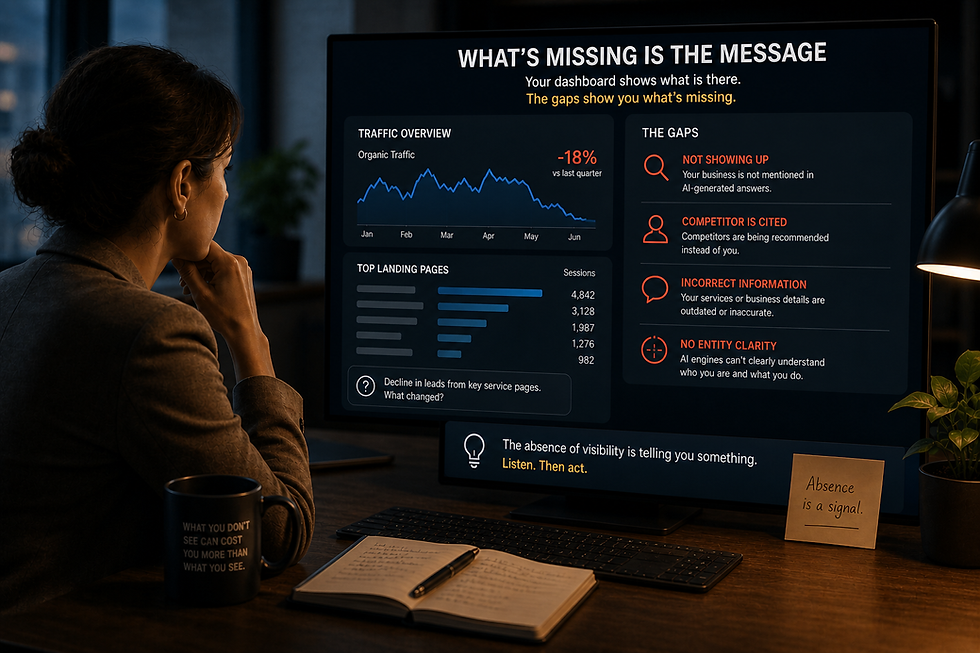
Most owners look at their numbers and ask what is happening. The sharper question is what should be happening that is not.
A type of inquiry that used to come in has gone quiet. A referral source that ran consistently has stopped. A search term that drove leads last quarter produced none this quarter. These absences are signals. They are usually invisible because dashboards are built to show what is present, not what has gone missing.
The same logic applies to AI visibility. Run your business through ChatGPT and watch what is not there. If your competitor is named and you are not, that is information. If your services are described incorrectly, that is information. If the engine cannot tell who runs the business, that is information. The work is to find the gaps, decide which ones matter, and close the ones that do.
The vocabulary is unsettled - the practice is not
You will see acronyms passing through marketing conversations. AEO. GEO. AIO. Some practitioners use one. Some use another. Some use them interchangeably and argue about it on LinkedIn.
Do not get attached to the acronym. Get attached to the underlying practice, which is making sure your business is accurately represented inside the engines where your customers now ask questions. The label will sort itself out in the next twelve to eighteen months. The practice does not wait.
What to Do This Quarter
Open ChatGPT. Perplexity. Google AI Overview. Type the questions your customers ask before they hire you. Some version of "best [your service] in [your city]." Some version of "how do I [problem you solve]." Some version of "is [your business name] legitimate." Read what the engines say. Capture which sources they cite. Note whether you appear, whether you are described correctly, and whether you appear at all.
One hour of that work will tell you more about your current visibility than most analytics dashboards will tell you in a quarter.
From there, three moves matter.
Treat your website as an entity-defining surface. AI engines need structured information about who you are, what you do, where you operate, and who runs the business. Most small business websites are organized around what the owner wants to say. Restructure around what an engine needs to understand. Add a clear FAQ block to every service page using the exact questions clients ask. Keep answers between forty and eighty words. Implement schema markup for Local Business, Service, FAQ Page, and Person. These are not luxuries. They are how meaning gets transmitted to a machine.
Audit your presence on the sources AI engines cite for your category. For most local service businesses in the Permian Basin, that means Google Business Profile, Yelp, the local chamber, industry directories, and increasingly Reddit and YouTube. If those sources describe you incorrectly or do not mention you, no amount of homepage work will solve it.
Build brand-level content tied to you and your business as searchable entities. Founder-led writing. LinkedIn articles. Podcast appearances. Detailed Google reviews that name specific services. These are the materials engines use to construct their picture of who you are. Most small businesses have a thin brand layer and a thick service layer. The shift inverts which one is worth more.
Attention Is the Real Advantage
I work in the space between business strategy and human performance. I notice the same pattern in both. Most outcomes do not break because of effort. They break because of attention.

People keep doing what worked last year, long after it stopped working, and the gap between assumption and reality widens until something breaks visibly enough to force a response. By the time it breaks, the cost of repair is much higher than the cost of awareness would have been.
This shift is one of those quiet ones. It is not loud yet. The numbers will not crash overnight. The traffic will erode in increments. The leads will get a little harder to come by. The customers who used to find you will find someone else, and you will not always know why.
Owners who pay attention now will be a year ahead of those who wait until the change becomes obvious.
Your Business Sidekick!
I have worked with entrepreneurs and small business owners across Midland, the Permian Basin, and beyond for over seven years. The pattern I see most often is not laziness. It is not even a lack of skill. It is the assumption that what worked last year will keep working this year. That assumption is breaking right now, quietly, in the space between what owners think their customers are doing and what those customers are actually doing.
This is not a moment for panic. It is a moment for attention.
The businesses paying attention now, and adjusting deliberately, will be the ones still being named when the customer who matters opens an answer engine and asks the question that leads to a decision.
At BAM, this is the work we are now building into how we help operators get found, get chosen, and get paid. The shift is here. The only question left is where you stand inside it, and how you intend to move.


Comments